Diesel clothing did a photo shoot at the Brooklyn Law Library and the New York Transit Museum. The photos have been categorized as "racy" and "shocking". Diesel paid for the use of the Transit Museum space, and the museum was closed to the public during the shoot. Is the payment for the space enough to give Diesel carte blanche to create whatever type of photos they wanted? Is the money worth the possible hit to the museum's reputation?
Tuesday, November 16, 2010
Is the money worth it?
http://www.upi.com/Odd_News/2010/11/16/Racy-ad-photos-taken-at-museum/UPI-37521289949969/

Saturday, November 13, 2010
Liberace Museum Hits a Bad Chord

The Liberace Museum in Las Vegas is closing it's doors due to financial troubles and what the board calls, "a waning interest". In reading the article, it seems that there are more troubles behind the scenes than just a lack of interest in the entertainer from the general public. What do you think are some of the major issues facing the museum? If you were involved with the museum, how might you have handled things differently (including the sale of the antique desk and staffing decisions)?
Wednesday, November 10, 2010
Egyptian repatriation tactics

http://online.wsj.com/article/SB10001424052748704689804575535662169204940.html
Zahi Hawass, Secretary General of the Supreme Council for Antiquities in Egypt has been lobbying for the return of Egyptian cultural objects from various museums around the world. The latest museum to return objects is the Metropolitan Museum of Art in New York City. A series of objects that ended up at the museum after Howard Carter's discovery of King Tut's tomb are being returned to Egypt, with the reasoning being that they never should have ended up at the museum in the first place. Ok, so then why did they end up there at all, and for nearly 100 years??
More importantly, though, are the tactics Dr. Hawass is employing in his lobbying. If he can't get his way through negotiation, he threatens to ban archaeologists affiliated with certain museums from digging in Egypt at all. (I.e. Museums he wants to get stuff back from who have yet to comply).
A new museum is being built in Cairo, and some of this pressure to get objects back seems to give the impression that the Egyptian government doesn't have enough material already to fill the museum (Unlikely, with several thousand years worth of history at their feet).
Some museums have refused to give back objects, stating that the circumstances under which they were acquired (in one case, as spoils of war), are not affected by some of the international treaties that are being cited by Dr. Hawass.
So, what do you think? Is Dr. Hawass using his position in the government to strong arm other museums into doing his bidding? What do you think of his tactics? Are they justified or a form of bullying? What about the ethical vs legal argument (that is, it might be legal for a museum to hang onto some of the Egyptian goods that they have, but is it ethical?)
More importantly, though, are the tactics Dr. Hawass is employing in his lobbying. If he can't get his way through negotiation, he threatens to ban archaeologists affiliated with certain museums from digging in Egypt at all. (I.e. Museums he wants to get stuff back from who have yet to comply).
A new museum is being built in Cairo, and some of this pressure to get objects back seems to give the impression that the Egyptian government doesn't have enough material already to fill the museum (Unlikely, with several thousand years worth of history at their feet).
Some museums have refused to give back objects, stating that the circumstances under which they were acquired (in one case, as spoils of war), are not affected by some of the international treaties that are being cited by Dr. Hawass.
So, what do you think? Is Dr. Hawass using his position in the government to strong arm other museums into doing his bidding? What do you think of his tactics? Are they justified or a form of bullying? What about the ethical vs legal argument (that is, it might be legal for a museum to hang onto some of the Egyptian goods that they have, but is it ethical?)
A Presidential Legacy
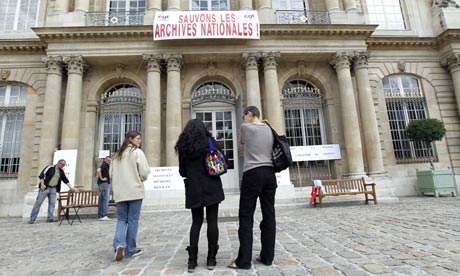
French President Nicolas Sarkozy has decided to create a museum of French history in Paris, attempting to create his own legacy a la Francois Mitterand and the Louvre pyramid and Georges Pompidou and the art museum named after him. However, theres a problem with Sarkozy's plan...or a few problems. First is his choice of venue, the French National Archives. For one, the building is already claimed...and in heavy use. The archivists there say that they already don't have enough space, and two, they've already got a renovation of the interior of the space used for their own purposes, not Sarkozy's. The staff of the archive is trying to make their point to Sarkozy by staging a peaceful sit in, which has gone on for 2 months at this point. Residents seem to be behind the archivists, rather than the President. Further, the impression that is being given by choosing a palace for the French National Museum is one of history being about the upper classes, not the working people. Whether that was his intention or not in choosing such a location, Sarkozy is also being accused of trying to subvert history for his own right wing purposes.
So, what do you think? Is Sarkozy trying to make history into something it's not? How would you go about choosing and setting up a museum of French history? Do you think the archivists sit in is effective? What might you do differently?
Sunday, October 31, 2010
Have we taken things too far?
http://www.dailymail.co.uk/news/article-1323443/Museum-displays-human-remains-covered-fear-offending-pagans.html
Museums all over the world have been dealing with repatriation of indigenous objects, most recently in the US with the advent of NAGPRA, the North American Graves Protection and Repatriation Act. NAGPRA and similar statues require museums that receive federal funding to return human remains and funerary goods, as well as assorted other objects, to their country or culture of origin.
Now, however, museums in the UK have taken things a step further, and have taken to covering up or hiding away skeletons for fear of offending visitors in general, and a Pagan group called Honoring the Ancient Dead in specific. Have we taken political correctness too far? Should groups to which the deceased once belonged (tribes, clans, etc) be allowed to have a say, but not others? Some museums in the UK rescinded their decision after public outcry. Have we taken things *too* far, and have come back around again, offending a large group to make a small group happy? Or is this the new reality for museum professionals, that we, as new members of the community, must simply accept?
Museums all over the world have been dealing with repatriation of indigenous objects, most recently in the US with the advent of NAGPRA, the North American Graves Protection and Repatriation Act. NAGPRA and similar statues require museums that receive federal funding to return human remains and funerary goods, as well as assorted other objects, to their country or culture of origin.
Now, however, museums in the UK have taken things a step further, and have taken to covering up or hiding away skeletons for fear of offending visitors in general, and a Pagan group called Honoring the Ancient Dead in specific. Have we taken political correctness too far? Should groups to which the deceased once belonged (tribes, clans, etc) be allowed to have a say, but not others? Some museums in the UK rescinded their decision after public outcry. Have we taken things *too* far, and have come back around again, offending a large group to make a small group happy? Or is this the new reality for museum professionals, that we, as new members of the community, must simply accept?
Monday, October 25, 2010
Do Deaccessioning Standards Apply to Everyone?
Fisk College in Tennessee is in need of some serious cash, and is looking to sell the Stieglitz collection that it houses on campus, donated by Georgia O'Keefe. http://www.tennessean.com/article/20101025/NEWS01/101025078/Fisk+rejects+new+proposal+over+art+collection
The AAM states that any money raised from deaccessioning artwork (which Fisk effectively wants to do, by selling it's portion of the collection to another institution) must go back towards the collection, and not to operating costs. Is this a similar situation, even though it's a college, and not a museum in the traditional sense? What about the fact that an anonymous donor has already stepped forward and offered money to cover the care of the collection at no cost to the college (the college's argument for selling it is that it is too much of a financial burden to maintain the collection), thus the college could divert the funds currently used for collection care to operating costs. Does that change whether the college should be allowed to sell the collection?
The AAM states that any money raised from deaccessioning artwork (which Fisk effectively wants to do, by selling it's portion of the collection to another institution) must go back towards the collection, and not to operating costs. Is this a similar situation, even though it's a college, and not a museum in the traditional sense? What about the fact that an anonymous donor has already stepped forward and offered money to cover the care of the collection at no cost to the college (the college's argument for selling it is that it is too much of a financial burden to maintain the collection), thus the college could divert the funds currently used for collection care to operating costs. Does that change whether the college should be allowed to sell the collection?
The Art of Perception
CIA and FBI agents have been sent to the Met in New York City to refresh their powers of observation: http://www.telegraph.co.uk/news/worldnews/northamerica/usa/8086280/CIA-and-FBI-sent-on-museum-course-to-refresh-sense-of-inquiry.html
There are a couple of interesting things about this article. First, it was found in a UK newspaper, rather than a US one (in fact, that was the first place I heard anything about it.) Second, for those of you in Museums Today this semester, we learned about the medical student beginnings of this program, and the use of Visual Thinking Strategies (VTS).
So now I've seen it used in medical school, reportedly teaching future doctors how to just LOOK at a patient, observe their symptoms, and really take everything in, and have seen the FBI and CIA use it to refresh powers of observation with respects to crime scenes. Do you think VTS really has an effect on these situations, or is it just due to the participants being in a different setting? Do you think that the effects could be diminished by seeing crime scenes or patients day after day? Are there other fields that VTS and specifically The Art of Perception could be applied to?
There are a couple of interesting things about this article. First, it was found in a UK newspaper, rather than a US one (in fact, that was the first place I heard anything about it.) Second, for those of you in Museums Today this semester, we learned about the medical student beginnings of this program, and the use of Visual Thinking Strategies (VTS).
So now I've seen it used in medical school, reportedly teaching future doctors how to just LOOK at a patient, observe their symptoms, and really take everything in, and have seen the FBI and CIA use it to refresh powers of observation with respects to crime scenes. Do you think VTS really has an effect on these situations, or is it just due to the participants being in a different setting? Do you think that the effects could be diminished by seeing crime scenes or patients day after day? Are there other fields that VTS and specifically The Art of Perception could be applied to?
Subscribe to:
Posts (Atom)